

QuantumScape CTO on Eagle Line’s Role as Tech Demonstrator for Solid-State Battery Production
February 9, 2026
At a Glance
- QuantumScape’s Eagle Line proves solid-state battery manufacturing can scale from lab to commercial production.
- CTO Tim Holme explains how Eagle Line creates replicable manufacturing blueprint for solid-state battery partners to follow.
- QuantumScape Eagle Line demonstrates ceramic separator breakthroughs that compress processing from days to minutes.
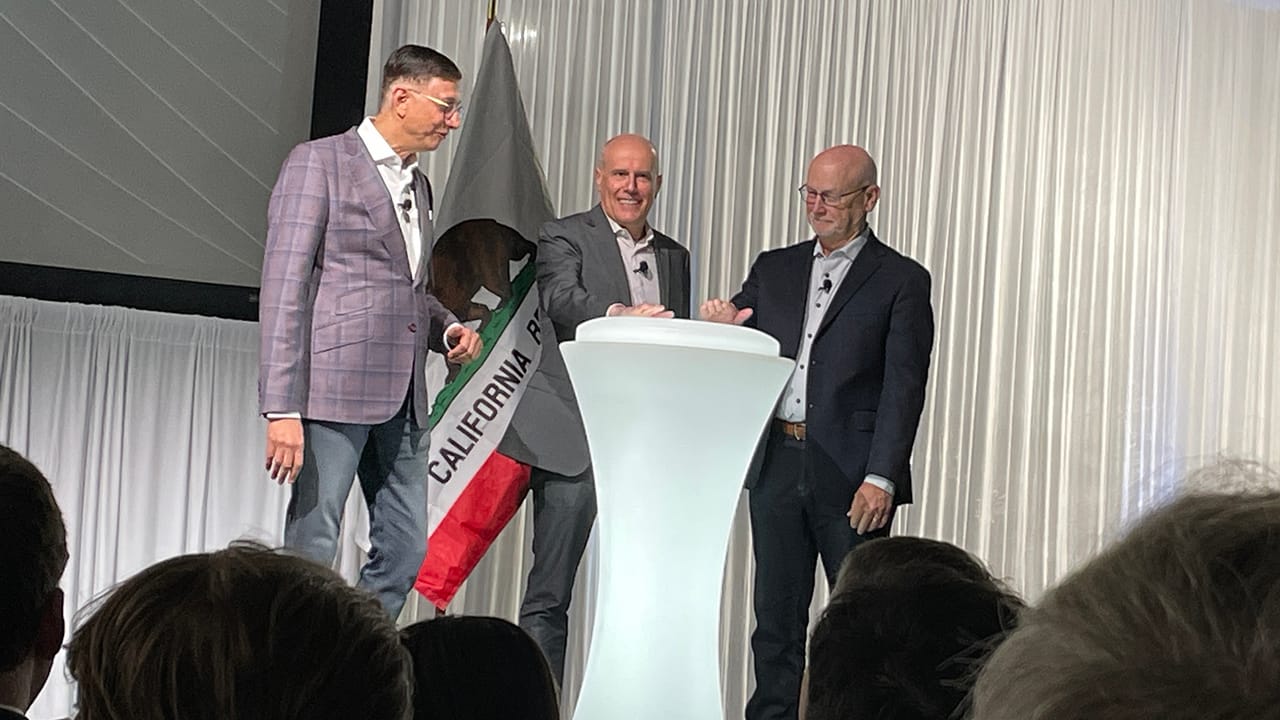
The February 4 launch of QuantumScape’s Eagle Line production facility in San Jose represents more than just another manufacturing milestone—it’s a critical proof point that solid-state battery technology can transition from laboratory curiosity to scalable production. In a conversation with Battery Technology, Chief Technical Officer Tim Holme explained that the facility addresses what he calls the industry’s most daunting challenge: scaling battery production across “13 orders of magnitude” from benchtop prototypes to gigawatt-hour manufacturing. But unlike traditional battery companies, QuantumScape isn’t building this capability for its own mass production ambitions—it’s creating a replicable blueprint for automotive and industrial partners to license and implement.

QuantumScape Chief Technology Officer Tim Holme. Credit: M. Anderson / Battery Technology
Ceramic separator breakthrough
At the heart of QuantumScape’s technology lies a breakthrough that sounds almost mundane until you understand its implications. The company has compressed a ceramic processing step that traditionally takes competitors days or weeks into a matter of minutes—a transformation that required four years of intensive research and development and now serves as the foundation for its licensing strategy.
“If you make pottery, you know, form a pot, and then you put it into an oven, and it can take two days or so to bake,” Holme said. “So it’s that step that we shrunk down from a few days long to minutes long.”
This ceramic separator represents the most differentiating element of QuantumScape’s solid-state battery technology. Unlike liquid electrolytes in conventional lithium-ion batteries, this solid ceramic material conducts lithium “nearly as fast as lithium flows through water” while providing superior stability and safety characteristics. The breakthrough required fundamental innovations in ceramics science, which is remarkable for a field that has existed for tens of thousands of years.

QuantumScape flexible separator. Credit: QuantumScape
The manufacturing speed improvement isn’t just about efficiency; it’s essential for economic viability that licensees can achieve. “It was a key enabler to us being able to approach battery scale and cost, because it’s that kind of throughput that is needed to produce at gigawatt hours,” Holme noted. More importantly for QuantumScape’s business model, it’s a process that can be taught, replicated, and scaled by partners rather than requiring the company to become a manufacturing giant itself.
Engineering precision as intellectual property
The Eagle Line facility showcases a different type of engineering challenge than QuantumScape’s earlier Cobra Line, which focused on the complex chemistry of separator production. While the Cobra Line required controlling atoms at the molecular level, the Eagle Line represents a mechanical engineering feat involving 14 different pieces of automated equipment working in perfect synchronization—all designed to be reproducible by licensees.
Each robotic system must perform precise motions coordinated with the others, creating what Holme describes as a more straightforward but equally demanding challenge. The facility incorporates Fanuc automation systems, with QuantumScape working both with system integrators and handling some fabrication internally to optimize speed and precision.
Daniel Braithwaite, VP of Hardware, Automation & Metrology, shares a look at Eagle Line automation equipment at QuantumScape. Credit: M. Anderson / Battery Technology
This level of automation becomes crucial when considering the scale challenge that QuantumScape is solving on behalf of the entire industry. Holme breaks down the magnitude of scaling from laboratory to commercial production in stark terms: “There are 13 orders of magnitude between making batteries on bench top and a gigawatt hour. The first order of magnitude you get by working all day, and two orders of magnitude after that, you work all year, and then you hire a team of 100 people. So you’ve done now five orders of magnitude. You’ve got a team of 100 people working year round, and you still have eight orders of magnitude to go from there to a giga factory.”
The remaining scaling requires automation factors of 10, repeated eight times—each step representing a significant engineering challenge that QuantumScape is solving once so that multiple licensees can benefit from the solution.
Real-world validation for production credibility
QuantumScape’s confidence in its licensing approach stems from successful real-world demonstrations that moved beyond controlled laboratory conditions. A pivotal moment came when Ducati integrated QuantumScape batteries into a world-class racing motorcycle displayed at the Munich Auto Show, proving the technology could perform in demanding applications outside the lab—exactly the kind of validation potential licensees need to see.
This progression from laboratory to motorcycle to automotive applications follows a deliberate timeline designed to build licensing credibility. “Last year we showed demo motorcycles,” Holme explains. “This year we’re going to be doing more real-world on-road testing, and the next couple of years, that’s going to move from motorcycles to cars.”

Ducati prototype of its V21L electric motorcycle, equipped with QuantumScape solid-state batteries, at the 2025 Munich Auto Show. Credit: Dan Carney
The Eagle Line serves as both a production facility and a comprehensive demonstration for potential partners. As Holme emphasized, “It’s a pilot meant for mass production. It’s meant as a learning tool and as a blueprint for others to follow.” This approach allows QuantumScape to identify and solve scaling challenges before partners attempt their own production facilities, de-risking the licensing proposition.
Strategic partnership with VW’s PowerCo
QuantumScape’s collaboration with Volkswagen’s PowerCo division provides both validation of the licensing model and acceleration for commercial development. The partnership involves two separate agreements, each worth approximately $130 million, giving PowerCo significant influence with two board seats and engineers stationed at QuantumScape facilities—essentially a deep dive into the technology before broader licensing.
This deep integration serves as a proof-of-concept for the licensing approach. “We’re extremely incentivized to work with them, because it’s going to be the fastest pathway to market,” Holme noted. The collaboration follows automotive industry standard development phases, with QuantumScape having completed A Sample prototypes and now producing B Samples from the pilot line. The next phase involves joint development of C Samples from production-scale facilities that PowerCo will ultimately operate using QuantumScape’s processes.
Importantly, Holme estimates that “98% of it probably would apply to other customers as well,” with variations mainly in form factors requiring different tooling rather than fundamental process changes. This standardization is crucial for a successful licensing strategy, allowing QuantumScape to develop core processes once while accommodating customer-specific requirements through modular adjustments.
Market realities and full-production timelines
While competitors make aggressive production timeline claims—some suggesting commercial production within this quarter—Holme provides a more measured assessment that reflects the licensing development cycle. The progression from current pilot production to commercial scale through partners will unfold over “a few years,” driven by the collaboration with PowerCo and the inherent challenges of transferring complex manufacturing processes to licensees.
This timeline reflects QuantumScape’s founding thesis that existing battery technology was “good enough to get early adopters, but not good enough to capture the mass market.” With EV penetration currently at 5-10% depending on geography, Holme believes solid-state batteries addressing faster charging, longer range, and lower costs will “really accelerate the adoption of electric vehicles and of electrification in general”—but through multiple licensees rather than QuantumScape’s own manufacturing scale-up.
Beyond automotive applications
The technology’s potential extends beyond automotive applications, with QuantumScape already partnering with stationary energy storage companies to explore additional markets. However, Holme sees the technology as best suited for applications prioritizing safety or high performance rather than cost-optimized utility-scale installations—guidance that helps potential licensees understand where the technology provides the greatest competitive advantage.
The Eagle Line facility represents an inflection point in solid-state battery development—demonstrating that laboratory breakthroughs can translate into scalable manufacturing processes that others can implement. While significant challenges remain in reaching gigawatt-hour production scales, QuantumScape’s systematic approach to solving the “13 orders of magnitude” problem creates a replicable roadmap that licensees can follow rather than requiring each company to solve these challenges independently.
As the facility ramps up production and generates real-world performance data, it will serve as both a commercial validation tool and a comprehensive demonstration facility for potential licensing partners. This approach allows QuantumScape to focus on what it does best—breakthrough technology development—while enabling the broader industry to handle the capital-intensive work of mass production through proven, licensed processes.
The Eagle Line’s success ultimately won’t be measured by QuantumScape’s own production volumes, but by how effectively it enables partners to bring solid-state batteries to mass market adoption through a proven, scalable manufacturing blueprint.
Source:QuantumScape CTO on Eagle Line and scaling solid-state tech